
As June approaches, thoughts turn to ripening fruits and for many, who do not have the space or time to grow their own, the “pick your own” fruit farm is the ideal place to be. [Read more…] about Pick Your Own
Schools grow their own
Schools across Cumbria are being encouraged to spring into action and enter the Grow Your Own competition, run by Booths and The World of Beatrix Potter.

Over 40 primary schools have already registered to take part in the competition but time is running out for other schools to get their entries in for the contest, which challenges local schoolchildren to get set and grow their own fruit and vegetables. [Read more…] about Schools grow their own

New Seashore Foragers’ Handbook
 The seashore holds surprising culinary potential for the forager and the new book “The Edible Seashore” covers everything you need to know about harvesting the bounties of the shoreline! [Read more…] about New Seashore Foragers’ Handbook
Home Made Yoghurt
In our goal for self sufficiency, we have introduced a yoghurt maker to the kitchen and the result has been excellent.
We purchased our yoghurt maker from Lakeland, it is very simple, compact, easy to clean and for those not familiar to making yoghurt, contains a simple instruction leaflet. This unit can make 1.5pints at a time, enough for a family!

Yoghurt can be made from a variety of milk types, such as pasturised, sterilised, UHT and evaporated. The Lakeland leaflet states that UHT makes the best but we tried ours with pasturised semi skimmed milk. My preference will be to use Jersey milk of which we have a few local suppliers in Cumbria.
The standard pasteurisation process is not sufficient to render milk fit for yoghurt making, but simply bringing it to the boil then allowing it to cool at room temperature until it reaches 47 degrees Celcius works well.

A small amount of starter yoghurt (a couple of teaspoonsfull of natural unsweetened, LIVE yoghurt) is placed in the base of the container and the cooled milk is gently stirred into this, being careful not to stir too vigorously.


The container is placed in the heater unit and switched on. left for about 7 hours, so ideally overnight, you will have lovely creamy yoghurt to which you can add fruit, cereals or even herbs and spices to make some wonderful dips.
This is certainly a cost saving exercise and the result is just as good as bought yoghurt and will keep in the fridge for around five to six days. When it’s nearly finished you can use a few spoon full to start off your next pot.
Further interest:
The Cottage Smallholder – How to make delicious Greek Style Yoghurt.
About.com – How to make home made yoghurt.
Eat Yoghurt.com – For some great recipes using yoghurt.

Useful Sites
To help you get the best from your weekly shopping and control a tight food budget, you may get some useful hints and advice from the following sites:
How to make an easy rice pudding
If you are looking for a simple to make family pudding then you can not go far wrong with this recipe for a rice pudding.
This pudding is ideal for a cheap, easily made, ballast kind of pudding. Great for cold winter nights when you just need a bit of fuel in the tummy at the end of the day.
We are going to make the pudding in a microwave. It is by far the cleanest and most efficient way as it avoids stirring a pan on the stove constantly.

Measurements are flexible, and put together by a boy in the UK, so can be tweaked to suit your particular circumstances. We estimate this recipe will produce 4-6 good growing boy sized portions.
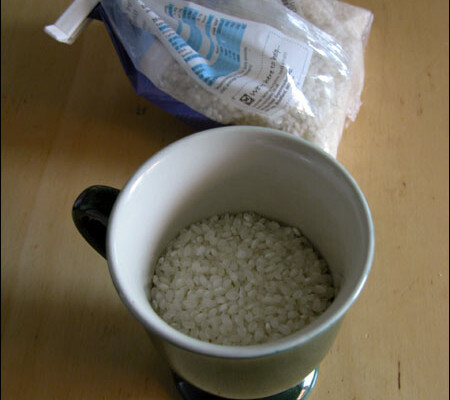
Start with about half a mug of Pearl Rice ( very short grain pudding rice). This is easily purchased from most stores. Make sure you do not get long grain rice – thats the stuff you would put with a curry.
Put the rice into the bottom of a big glass microwave suitable bowl. Use the largest bowl for your microwave as the milk will boil up the sides.
Add to the bowl around 2.5 pints of milk.

For luxury you could use full fat milk, or maybe substitute some of the milk for a can of evaporated milk, but usually we use semi-skimmed milk.
We are lucky here as we have an old fashioned milk delivery.
The milkman arrives in the early hours and delivers the milk fresh from the dairy in glass milk bottles.
He then takes away rinsed out used bottles for cleaning and refilling.
This is a fantastic, green service that has gone on in the UK for many, many years and well before recycling had a name.

Add around half a grated whole Nutmeg, or use around half a teaspoon of ground nutmeg, to the bowl.
This will give the pudding a slight spicy taste and fill the whole house with a great warming scent as it cooks
Nutmeg is used in many dishes but also in perfumes and medicines.
Originally brought from the Spice Islands in Indonesia the nutmeg reached the Caribbean around 1824. It is from here that around 40% of the worlds crop of nutmegs now come from.
Add sugar to taste. Usually we add about a tablespoon full.
Stir all of the ingredients together and put into the microwave.
Temperatures vary with all machines so as a basis we suggest keeping an eye on the cooking process and making sure nothing boils over or seems to be going wrong.
Normally we set the cooking time to around one hour on simmer after about 10 minutes on full. What you are trying to achieve is the reduction in the milk into a creamy consistency. You may need to cook longer or shorter to achieve the consistency you are looking for.
We suggest that every so often you remove the bowl from the microwave and give it a stir, just to keep the rice and milk mixed up.

This rice pudding is ideal for creating during the day then reheating later in the day.
Here you would remove the bowl from the cooker and covering it, allow it to cool. Maybe putting in a fridge once cool enough.
Reheating is easy. Just put the bowl back in the microwave for a few minutes on a medium heat until hot.
Serve the pudding maybe with some fresh strawberries or pickled plums to suit.
Here are some other Rice Pudding recipies we have found on the web
Rose Tea Rice Pudding, a Persian-Chinese Concoction
Yummy Rice Pudding from Scratch